Version History
How the Vinara script evolved through four versions. This is the real story of its development.
Version 1 — The Symmetry Experiment
The original idea was not just to make Thaana LTR — it was to make an alphabet that could be written in both directions.
The concept: design characters that only extend vertically and are symmetrical horizontally — so they look the same whether read left-to-right or right-to-left. One script that works with both Thaana and Latin text regardless of direction.
The challenge: designing 24 truly symmetrical characters that are also visually distinct from each other is extremely difficult. The version was never completed.
Version 2 — Flipped Thaana
Abandoning the symmetry goal, version 2 took a simpler approach: just flip Thaana to LTR.
The goal was to stay as close to the original Thaana characters as possible — mirror them horizontally. This way existing Thaana readers could recognize the letters immediately.
This version still only had the original 24 Thaana consonants. No vowels, no extra letters. The scope was deliberately narrow — no "trying to do too much."
The problem that emerged: when you flip letters that were designed for RTL, some become ambiguous or too similar to each other. The visual logic of Thaana depends on its direction.
Version 3 — First Public Version
This was the first version shared publicly.
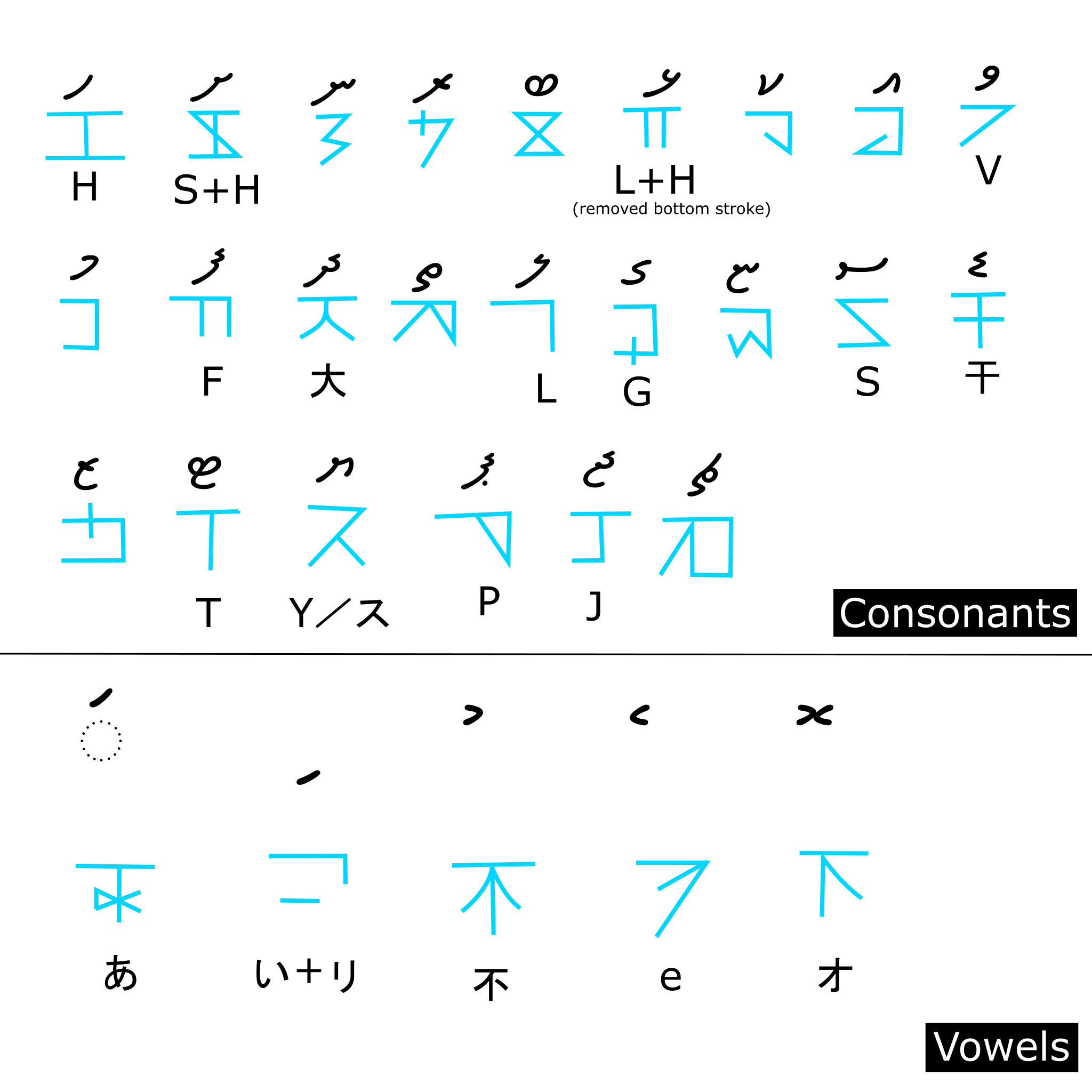
The core design decision: make every character visually distinct from every other character. This came from a personal experience learning Japanese — many unrelated Kana characters look similar to each other, creating unnecessary difficulty for learners. The same problem exists in Thaana for non-native learners.
Rather than designing random new shapes, inspiration came from Japanese and Chinese characters for two reasons:
- They are visually neater and more distinct compared to characters from the Indian subcontinent and Arabic (the origins of Thaana)
- The author was already studying Japanese and Chinese — no new visual language to learn, just adaptation
Several characters in v3 are directly taken or adapted from Japanese Kana and Chinese characters.
This version also introduced the vowel extender concept borrowed from Japanese ー and the idea of standalone vowel characters instead of diacritics.
The problem that emerged: every character in v3 was built from straight lines — highly angular. This made it readable on screen but extremely difficult to write by hand on paper.
Version 4 — Current Version
The angular characters of v3 needed to be made writable by hand without losing their screen readability.
The approach: take each v3 character and introduce gentle curves while keeping the core shape. Not decorative curves — functional ones that make the pen stroke natural.
For characters that were either too similar to existing Vinara, Thaana, or Latin characters, or that didn't curve naturally — inspiration was taken from Dhives Akuru, Thaana's predecessor script which was itself written LTR.
The four missing English consonants (C, W, X, Q) were added in this version — taken directly from their Latin forms but adjusted to match the visual style of the Vinara character set.
The vowels were kept close to their English equivalents — a deliberate choice. Short vowels in English and Dhivehi overlap significantly in sound, and since the vowel keys would be used for English orthographic writing anyway, visual similarity to English vowels made the most practical sense.
This is the version in use today.
Consonants (1–24)
Haa (h)
Thaana equivalent: ހ. Introduced in v3. Origin: Thaana. A simple, open shape that sets the tone for the geometric style.
Shaviyani (sh)
Thaana equivalent: ށ. Introduced in v3. Origin: Thaana. The shifted form of haa, preserving the Thaana relationship where the two characters are visually related.
Noonu (n)
Thaana equivalent: ނ. Introduced in v3. Origin: Dhives Akuru 𑤐. A compact, closed form designed for maximum clarity at small sizes.
Raa (r)
Thaana equivalent: ރ. Introduced in v3. Origin: Latin r. A flowing, open shape that was refined across versions to find the balance between distinctive and simple.
Baa (b)
Thaana equivalent: ބ. Introduced in v3. Origin: Latin b. A solid, grounded form with a strong horizontal base.
Lhaviyani (lh)
Thaana equivalent: ޅ. Introduced in v3. Origin: Dhives Akuru 𑤧. The lh sound is unique to Dhivehi — no direct equivalent in most other scripts.
Kaafu (k)
Thaana equivalent: ކ. Introduced in v3. Origin: Latin k. A sharp, angular shape designed to contrast with rounder forms.
Alifu (vowel carrier)
Thaana equivalent: އ. Introduced in v3. Origin: Dhives Akuru 𑤆. Not a consonant in the traditional sense — it carries vowels when no consonant precedes them. Its shape is deliberately simple because it appears so frequently.
Vaavu (v)
Thaana equivalent: ވ. Introduced in v3. Origin: Thaana. A symmetrical, balanced form refined in v4 for more distinction from other round characters.
Meemu (m)
Thaana equivalent: މ. Introduced in v3. Origin: Hiragana み. A wide, stable shape that fills horizontal space.
Faafu (f)
Thaana equivalent: ފ. Introduced in v3. Origin: Chinese 飞. An open, airy form designed to feel light, matching the breathy nature of the f sound.
Dhaalu (dh)
Thaana equivalent: ދ. Introduced in v3. Origin: Thaana. The dh sound is another Dhivehi-specific phoneme.
Thaa (th)
Thaana equivalent: ތ. Introduced in v3. Origin: Thaana. When it appears at the end of a word with no vowel, it is romanized as "iy".
Laamu (l)
Thaana equivalent: ލ. Introduced in v3. Origin: Dhives Akuru 𑤨. A tall, elegant shape that was one of the first to be finalized.
Gaafu (g)
Thaana equivalent: ގ. Introduced in v3. Origin: Dhives Akuru 𑤎. A strong, grounded form with solid vertical strokes.
Gnaviyani (gn)
Thaana equivalent: ޏ. Introduced in v3. Origin: Dhives Akuru 𑤕. The gn sound is relatively rare in Dhivehi, so this character was designed to be distinctive.
Seenu (s)
Thaana equivalent: ސ. Introduced in v3. Origin: Katakana フ. A clean, minimal form designed to be neutral — it appears in many words.
Daviyani (d)
Thaana equivalent: ޑ. Introduced in v3. Origin: Chinese 干. Refined in v4 to be more distinct from the baa character.
Zaviyani (z)
Thaana equivalent: ޒ. Introduced in v3. Origin: Dhives Akuru 𑤯. Given more movement in v4 to distinguish it from similar shapes.
Taviyani (t)
Thaana equivalent: ޓ. Introduced in v3. Origin: Dhives Akuru 𑤌. One of the most frequently used characters, so clarity was the top priority.
Yaa (y)
Thaana equivalent: ޔ. Introduced in v3. Origin: Latin y / Katakana ス. A friendly, approachable form.
Paviyani (p)
Thaana equivalent: ޕ. Introduced in v3. Origin: Latin p. Given a more vertical orientation in v4 to contrast with wider characters.
Javiyani (j)
Thaana equivalent: ޖ. Introduced in v3. Origin: Dhives Akuru 𑤣. A bold, assertive form designed to stand out in a line of text.
Chaviyani (ch)
Thaana equivalent: ޗ. Introduced in v3. Origin: Dhives Akuru 𑤒. The ch sound is common in Dhivehi, so this character needed to be both distinctive and easy to write.
Extra Consonants (25–28)
These four characters have no Thaana equivalent. They were added in v4 to give Vinara full coverage of English sounds.
C
No Thaana equivalent. Added in v4. Taken from the Latin C form and adjusted to match the Vinara visual style.
Q
No Thaana equivalent. Added in v4. Taken from the Latin Q form with a descender to make it visually heavy and distinctive.
W
No Thaana equivalent. Added in v4. Taken from the Latin W form and adjusted to fit the geometric style.
X
No Thaana equivalent. Added in v4. Taken from the Latin X form with strong diagonal strokes for visual distinction.
Vowels (29–35)
The six vowel characters are designed to be simple and uniform. Each follows the same basic structure, with variations that make them distinguishable at a glance.
A (short)
Thaana equivalent: ަ. Added in v3. Origin: Latin a. Kept close to the English lowercase "a" form — a deliberate choice since the vowel keys are used for English orthographic writing too.
E (short)
Thaana equivalent: ެ. Added in v3. Origin: Latin e. A variation of the A shape with a different internal structure.
I (short)
Thaana equivalent: ި. Added in v3. Origin: Hiragana い. A compact vowel form designed to feel light and quick.
O (short)
Thaana equivalent: ޮ. Added in v3. Origin: Thaana ޮ. A round, open vowel form given more curvature to match the roundness of the sound.
U (short)
Thaana equivalent: ު. Added in v3. Origin: Thaana ު. A wide, stable vowel form designed to feel grounded.
Vowel Extender
No Thaana equivalent. Added in v3. Origin: Katakana ―. Borrowed directly from the Japanese long vowel mark. When placed after a vowel, it extends that vowel into its long form. A simple, functional mark that is visually subordinate to the vowels it modifies.
Sukun
In Vinara, sukun is written using the 35th character, typed as Shift + q. When placed after certain consonants at the end of a word, it indicates no vowel follows (implied sukun).
- W + Q = h (glottal stop, އް)
- s + Q = s (ސް)
- n + Q = n (ން)
- T + Q = th (ތް)
- S + Q = sh (glottal stop, ށް)
In transliteration, you can type hh to specify ށް instead of އް.